How to Fix Washboard on a Gravel Road
Washboard — also called corrugation — is the most common complaint from private road owners. Those rhythmic ridges that shake your teeth loose and beat up your suspension form on almost every gravel road, no matter how well it was built. The good news: corrugation is fixable with or without heavy equipment, and with the right approach, you can slow it from coming back.
Grading a wet road makes things worse. Wait until the road surface is dry or barely damp. Grading when the road is saturated can destroy the base material and turn a washboard problem into a muddy rut problem that takes months to repair.
What Causes Washboard in the First Place?
Corrugation doesn't happen randomly. It's a mechanical resonance effect — tire bounce, amplified. When a vehicle hits a small bump in the gravel at speed, the suspension bounces the tire back down. That impact kicks loose particles forward. Over hundreds of passes, those kicked particles pile into a ridge. The ridge causes the next bounce. The cycle repeats and the ridges grow.
Four things make washboard form faster:
- Speed. Vehicles traveling over 20 mph create significantly more corrugation than those going under 15 mph. This is the single biggest factor you can control today.
- Wrong gravel. Clean, uniform stone (like pure 3/4-inch rock) has no fines to bind it. It rolls and kicks freely. A well-graded crusher run or 21A with mixed sizes and fines resists corrugation far better.
- Dry conditions. Dry gravel is loose gravel. Moisture binds particles together and reduces corrugation. This is why washboard is worst in mid-summer and after long dry spells.
- Missing crown. A road with no center crown forces water to run down the surface instead of off to the sides, which destabilizes the surface layer and accelerates corrugation.
How to Fix Washboard Without a Tractor
Most guides assume you have a box blade or motor grader. Many private road owners don't — and that's fine. Here are the practical options from least to most effort.
Option 1: A Tow-Behind ATV or Lawn Tractor Grader Blade
If you own an ATV, UTV, or even a riding mower with a tow hitch, a pull-behind drag blade or grader ($150–$400 at rural supply stores and online) can handle light to moderate washboard on roads up to about 1/4 mile. DR Power, Herd, and King Kutter all make durable models. The key technique:
Set the blade at a slight angle
Angling the blade about 15–20 degrees to the direction of travel lets it shave the tops of ridges and push material back toward the center without just pushing gravel into piles at the shoulders.
Make multiple slow passes
Go slow — 3–5 mph. One pass rarely fixes deep corrugation. Plan for 3–4 passes, alternating direction, until the surface is level. The vibration from an ATV at low speed actually helps break up compacted ridges.
Pull material from the shoulders back in
After flattening ridges, make one pass with the blade angled inward to drag gravel that has migrated to the edges back onto the road surface. Washboard pushes material outward over time, and you want it back in the middle.
Let traffic compact it, or use a lawn roller
After grading, driving over the freshly leveled surface several times at slow speed helps recompact the material. A water-filled lawn roller (rentable from most equipment rental yards for $40–$60/day) helps significantly on longer sections.
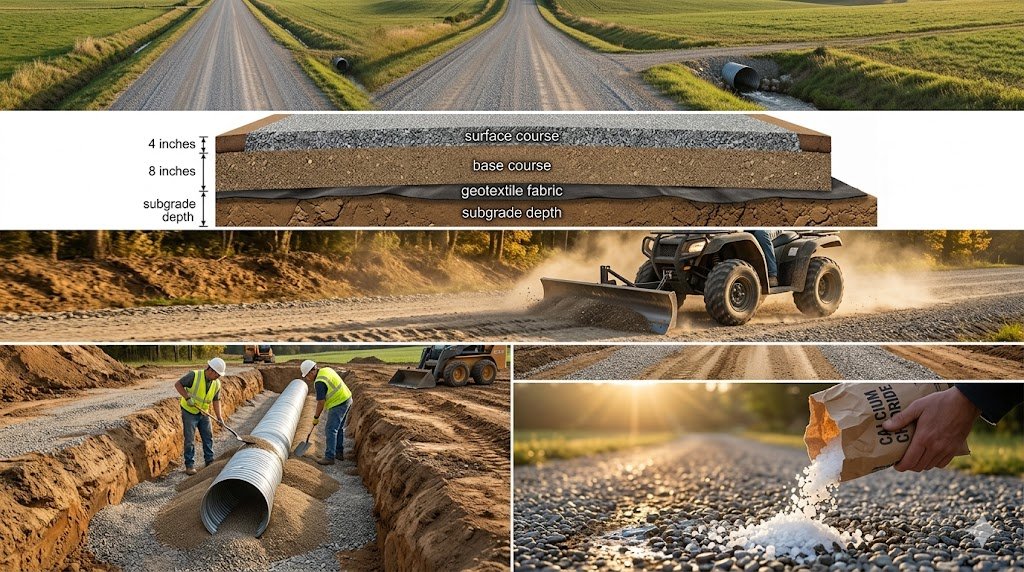
Option 2: Rent a Skid Steer or Tractor with Box Blade
For serious corrugation — ridges over 2 inches deep — the ATV drag approach is a temporary fix at best. A skid steer or compact tractor with a 6-foot box blade will do in two hours what an ATV drag takes a full day to do imperfectly. Equipment rental rates: skid steer typically $250–$380/day; compact tractor with implements $180–$280/day. Call your nearest Sunbelt Rentals, United Rentals, or Home Depot Tool Center.
The correct box blade technique for washboard:
- Set the blade to scarify (ripper teeth down) and make one pass at 2–3 inches of depth to break up compacted ridges
- Flip the ripper teeth up and make grading passes to redistribute material
- Build a slight crown (center of road 2–4 inches higher than edges for a 12-foot-wide road)
- Make final passes with downward blade pressure to smooth and recompact
Option 3: Hire a Local Grading Contractor
If your road is longer than 500 feet or the corrugation is severe, hiring a local excavating or land-clearing contractor with a motor grader is often the most cost-effective solution. A professional motor grader operator can grade 1/4 mile of road in under an hour. Expect to pay $120–$220/hour including the machine and operator in most rural markets. Ask them to "float grade" the surface — this means they lift the blade slightly at the end of each pass to avoid digging trenches at the turnaround points.
When hiring a grading contractor, ask specifically for "finish grading with crown." Many contractors default to a flat grade, which looks clean but drains poorly and will re-washboard faster. A proper 3–4% crown across the road width is what keeps water moving off the surface.
How Deep Should You Scarify Before Regrading?
This is where most DIY repairs go wrong. If you grade over the surface without breaking up the compacted ridges first, the washboard comes back within weeks because the hard base ridges are still there under the new loose material.
For corrugation up to 1.5 inches deep: surface grading only is usually sufficient.
For corrugation 1.5–3 inches deep: scarify 2 inches down, then regrade.
For corrugation over 3 inches deep: full reshaping is needed — rip to 4 inches, reshape the crown from scratch, add fresh gravel if needed.
The One Thing That Will Stop Washboard from Coming Back
Speed. Research from the University of Calgary and practical field experience both confirm that driving over 20 mph on a gravel road is the single biggest corrugation accelerator. If you (and anyone using your road) stay under 15 mph consistently, washboard will form at a fraction of the rate — giving you months instead of weeks between maintenance grading sessions.
If you share the road with other users, speed humps made from compacted road base (not asphalt speed bumps — those damage vehicles on unpaved roads) can force lower speeds. A simple 4-inch-tall by 6-foot-wide compacted gravel hump every 200 feet on problem sections is more effective than any number of signs.
When to Add Fresh Gravel
Regrading moves existing material around — it doesn't create new material. If your road has been maintained for several years without adding gravel, you may be working with less than 2 inches of actual surface material. At that point, grading mostly just scratches the underlying dirt or base. Signs you need new gravel before grading:
- You can see exposed dirt or the base layer in the ruts
- The graded surface looks thin and dusty rather than packed
- The road gets muddy after every light rain even in summer
For a standard 12-foot-wide road, adding 2 inches of crusher run costs approximately $1.80–$2.40 per linear foot of road depending on your region and haul distance from the quarry. Use the Gravel Calculator to estimate exactly how many tons you need before calling the quarry.
The Right Gravel Type Matters More Than Most People Think
If you're adding gravel and want to reduce future corrugation, choose a well-graded material with fines — not clean stone. The best performers for washboard resistance:
- Crusher run (also called dense-graded aggregate, 21A, or road base depending on region): A blend of crushed stone from 3/4 inch down to dust. The fines pack into the voids between larger stones, creating a cohesive, semi-bound surface that resists corrugation far better than clean stone.
- Caliche (in the Southwest and Texas): A naturally occurring calcite-rich material that hardens when wet and dry-cycles, forming an almost pavement-like surface. Exceptional corrugation resistance.
- Recycled asphalt millings: Surprisingly effective. The residual binder softens slightly in heat and rebinds, locking particles together. Can eliminate washboard on high-traffic sections entirely. See the full guide on recycled asphalt millings.
YITAMOTOR 8FT Heavy Duty Drag Harrow for ATV/UTV — Exactly the type of tool described in this guide. The 8-foot width covers a standard driveway in one pass. Heavy steel construction with 6FT tow chain, rust-resistant coating. Rated 4.5 stars from 121 reviews. This is the ATV drag that handles light-to-moderate washboard on driveways and short private roads — pull it at 3–5 mph for best results.
→ YITAMOTOR 8FT Heavy Duty Drag Harrow for ATV/UTV — Driveway Grader for Gravel ($159.99 on Amazon)
As an Amazon Associate, GravelRoadGuide earns from qualifying purchases.
Maintenance Schedule to Stay Ahead of Washboard
The best washboard strategy is catching it early. A light pass with an ATV drag when corrugation is just 1/2 inch deep takes 20 minutes. Waiting until ridges are 3 inches deep means a full day of work or a contractor bill. Most rural road owners who maintain their own roads find the following cadence works well:
| Season | Traffic Level | Recommended Action |
|---|---|---|
| After spring thaw | Any | Full reshaping — frost heave disrupts everything |
| Every 4–6 weeks | Daily (10+ vehicles) | Light ATV drag to knock down forming ridges |
| Every 6–10 weeks | Moderate (3–10 vehicles) | ATV drag or box blade pass |
| Every 2–3 months | Light (fewer than 3 vehicles) | Inspect and spot-fix problem areas only |
| Before winter | Any | Grade, crown, and clear ditches |
Frequently Asked Questions
Two reasons. First, if you graded over compacted ridges without scarifying first, the hard ridges are still there just below the surface — they re-appear as soon as the thin top layer wears away. Second, if the gravel type is wrong (clean uniform stone with no fines), it never binds and immediately starts corrugating again under traffic. Scarify before grading, and switch to a well-graded crusher run material with fines mixed in.
For light corrugation on a short section (under 100 feet), yes — a heavy-duty landscape rake can break up the tops of ridges and redistribute gravel. It's a lot of work, and you'll need to do it before traffic packs the ridges back down. A bow rake or gravel rake with sturdy metal tines works better than a standard leaf rake. This is not practical for longer roads or severe corrugation.
Light moisture — not soaking wet — is ideal. A slightly damp road grades more cleanly, and the moisture helps the redistributed material pack together. Grading immediately after a light rain is often ideal. Avoid grading if the surface is saturated, as this drags mud rather than gravel and can destroy the base. Some road owners with well water or a tractor with a water tank will lightly mist the surface before an ATV drag session.
For grading-only (no new gravel): $120–$250/hour for a motor grader and operator. Most private roads under 500 feet can be graded in under an hour. For roads that also need fresh gravel, add the material cost — typically $18–$30/ton for crusher run delivered, with most 12-foot-wide roads needing about 75–100 tons per 1,000 feet of road for a 2-inch top-dress. Get three quotes from local excavating or land clearing contractors, not paving companies (paving equipment is designed for asphalt, not gravel grading).
Yes, indirectly. Calcium chloride is primarily a dust suppressant, but because it keeps the road surface hygroscopic (it attracts and holds atmospheric moisture), it keeps the gravel slightly damp and bound. This significantly slows corrugation formation, especially during dry summer months when washboard forms fastest. See the full calcium chloride application guide for rates and timing.