Calcium Chloride for Gravel Road Dust Control: How Much, When, and How to Apply It
Calcium chloride is the most widely used and most effective DIY dust suppressant for private gravel roads and driveways. It works by absorbing moisture from the air and keeping the road surface slightly damp — which binds gravel particles together and prevents them from becoming airborne. Applied correctly, a single treatment controls dust for 6–12 weeks during dry weather.
This guide covers everything a private road owner needs to know: how it works, what to buy, exactly how much to apply, when to apply it, and whether it will damage your lawn, vehicles, or vegetation.
How Calcium Chloride Controls Dust
Calcium chloride (CaCl₂) is a hygroscopic salt — it aggressively pulls moisture out of the air and holds it. When spread on a gravel road surface, it draws enough atmospheric humidity to keep the top 1/2 inch of road material in a slightly damp, semi-bound state even during hot, dry weather. This prevents individual particles from becoming airborne when disturbed by vehicle traffic.
Unlike water (which evaporates quickly and needs daily reapplication) or oil (which contaminates soil and waterways), calcium chloride keeps working as long as some product remains on the road. It's especially effective in regions with nighttime humidity above 40–50%, because the road surface recharges itself overnight.
Calcium chloride works best on well-graded crusher run or road base that contains fines. On clean washed stone (pea gravel, 57 stone, river rock), there's nothing for the product to bind — the fines are what get damp and sticky. If your road is clean stone, calcium chloride will have minimal effect until you top-dress with crusher run.
What Form of Calcium Chloride to Buy
Calcium chloride for road use comes in three forms:
Flake (77–80% concentration)
The most common DIY form. Sold in 50-lb bags at farm supply stores (Tractor Supply, Southern States, Rural King), some home improvement stores, and online. Cost: $15–$25 per 50-lb bag. This is the standard form for private road owners treating driveways up to several hundred feet. Easy to apply by hand or with a walk-behind spreader.
Pellet (94–97% concentration)
More concentrated than flake — you need less by weight to achieve the same effect. Often sold as ice melt pellets (the same product, just marketed differently). Works well for dust control at lower application volumes. Cost: $20–$35 per 50-lb bag. Use at about 60% of the flake application rate.
Liquid (32–38% solution)
The form used by county road departments for large-scale application. Significantly cheaper per pound of active ingredient when purchased in bulk (250-gallon totes, $250–$400). Requires a spray tank and pump to apply — not practical for most homeowners unless you're treating long roads repeatedly. If you're treating over 1,000 feet of road annually, liquid becomes worth considering. Contractors who apply liquid can be hired in most rural areas for $0.08–$0.15 per square foot of road surface.
How Much Calcium Chloride to Apply: Application Rates
Application rates are expressed in pounds per square yard of road surface. The standard rates for flake (77–80%):
| Application Type | Rate (flake, 77%) | Frequency |
|---|---|---|
| Initial (first of season) | 1.0–1.5 lb per sq yd | Once, early summer |
| Maintenance application | 0.5–0.75 lb per sq yd | Every 6–10 weeks as needed |
| High-traffic roads | 1.5–2.0 lb per sq yd | Every 4–6 weeks |
Quick Bag Count Formula
To calculate how many 50-lb bags you need for an initial treatment at 1.0 lb/sq yd:
- Measure road length in feet × road width in feet = square feet
- Divide square feet by 9 = square yards
- Multiply square yards by 1.0 (or your target rate) = pounds needed
- Divide pounds by 50 = bags needed
Example: A 200-foot-long by 12-foot-wide driveway:
- 200 × 12 = 2,400 sq ft
- 2,400 ÷ 9 = 267 sq yd
- 267 × 1.0 = 267 lbs
- 267 ÷ 50 = 5.3 → 6 bags of flake (50 lb each)
Use the Gravel Calculator — it includes a calcium chloride estimator tab for quick bag counts.
When to Apply: Timing Is Everything
Getting the timing right doubles the effectiveness of every application.
Best time of year
Early summer — late May through mid-June in most of the US. This is when dust problems first appear (roads dry out after spring) and before the hottest, driest period. Treating early means the product is present during the peak dust season. A second application in late July or early August extends coverage through the rest of summer.
Best time of day
Early morning or evening, when humidity is highest. The calcium chloride needs initial moisture to begin dissolving and binding to the road surface. If you apply during the heat of the day on a very dry surface, the product just sits as dry crystals and blows away before it can do its job.
Apply before or after rain?
Apply when the road surface is slightly damp — either after a light rain event (wait until standing water has drained but the surface is still moist) or mist the road surface lightly with water from a hose before spreading. Do not apply to a bone-dry surface during a dry spell with no rain in the forecast. Heavy rain immediately after application will wash the product off the road before it can absorb.
If rain over 1 inch is forecast within 24 hours, wait. Heavy rain flushes calcium chloride off the road surface and into adjacent ditches and waterways before it can bind to the road. Applying right before a storm is money wasted and unnecessary discharge to drainage systems.
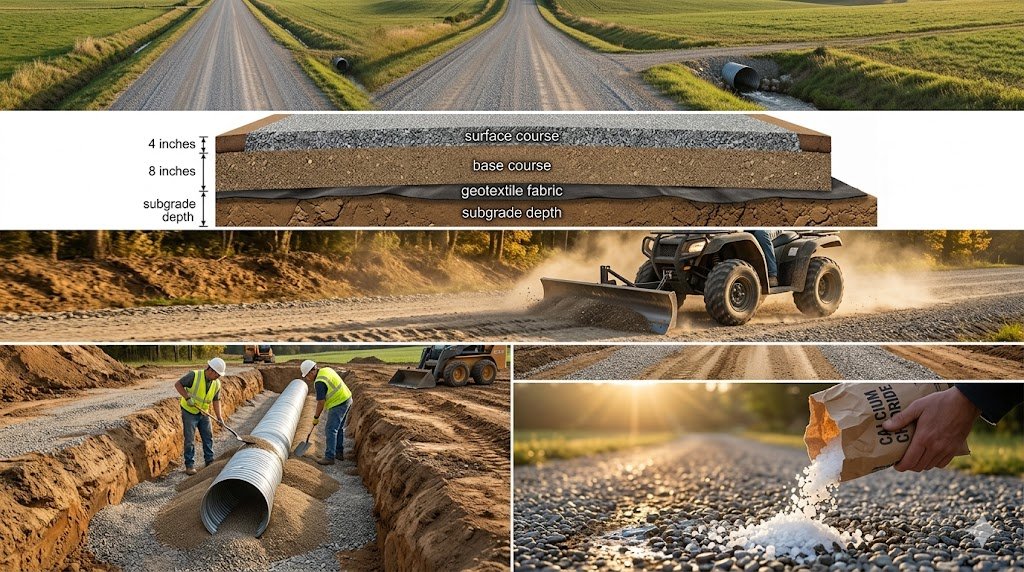
How to Apply Calcium Chloride (Step by Step)
Grade the road first if needed
If your road has significant washboard or ruts, grade before applying. Calcium chloride applied to a rough surface wastes product in the low spots and leaves the ridges untreated. A freshly graded, relatively smooth surface is the ideal starting point.
Lightly moisten the surface if dry
If the road is very dry, mist it with a garden hose or a water tank on a tractor. You want damp, not wet — water pooling on the surface means you've overdone it. Let excess water drain before applying product.
Spread evenly across the road width
For bags under about 10 bags total: spread by hand, walking in a consistent zigzag pattern across the road width. Wear rubber gloves — calcium chloride irritates skin and eyes. For larger areas, a pull-behind broadcast spreader (the kind used for lawn fertilizer) set to the lowest setting and driven at 5 mph works well. Set the spreader opening small — the product is much denser than fertilizer granules.
Allow traffic to work it in
Normal vehicle traffic over the next 24–48 hours helps press the product into the road surface and blend it with the fines. Don't restrict traffic after application — it's a feature, not a problem. The road will look slightly shiny or damp after the product activates, which is the correct result.
Will Calcium Chloride Damage Vehicles, Grass, or Plants?
Vehicles
Calcium chloride is corrosive to metal, exactly like road salt used for ice control. For vehicles regularly driven on treated roads, the same precautions as winter salt roads apply: rinse the undercarriage periodically, especially brake components, suspension parts, and exposed steel. The corrosion risk is real but manageable with routine washing. Most rural truck owners in treated-road areas wash their undercarriage once a month during dust control season.
Lawn and grass
Calcium chloride can kill or damage grass and other vegetation if it washes off the road edge in concentrated amounts. Avoid heavy application within 18 inches of the road edge where grass grows. On roads where runoff flows directly to lawn areas, the repeated low-level exposure can suppress or yellow grass along the road edge. In practice, most rural driveways have gravel shoulders or ditch lines that buffer the road edge from lawn areas.
Gardens and trees
Do not allow concentrated calcium chloride solution to drain into vegetable gardens or near established tree root zones. The salt concentration can damage roots and alter soil chemistry. If your driveway drains toward landscaped areas, redirect the drainage first or choose a different dust suppressant — see the dust control comparison chart for plant-safe alternatives.
Waterways
Calcium chloride is not regulated as a water pollutant in the same way as petroleum-based dust suppressants, but it does raise chloride levels in receiving waterways. Avoid direct application near ponds, streams, or wetlands. Most state environmental agencies consider properly applied calcium chloride on roads to be an acceptable practice; concentrated discharge from a flush-out event is where problems can occur.
Calcium Chloride vs. Magnesium Chloride: Which Is Better?
Both are hygroscopic chloride salts and work on the same principle. Key differences:
| Factor | Calcium Chloride | Magnesium Chloride |
|---|---|---|
| Cost | Lower ($15–$25/50 lb bag) | Higher ($22–$38/50 lb bag) |
| Effectiveness | Slightly more effective at same rate | Slightly less aggressive |
| Plant safety | More damaging to vegetation | Less damaging at road edge |
| Vehicle corrosion | More corrosive | Somewhat less corrosive |
| Availability | Very widely available | Less available in rural areas |
| DIY-friendliness | Excellent | Good |
For most private rural driveways away from landscaped areas and waterways, calcium chloride is the right choice — it's more available, less expensive, and equally effective. See the magnesium chloride guide for situations where it's the better option.
Frequently Asked Questions
In moderate conditions (temperatures under 90°F, some nighttime humidity), an initial application at 1.0–1.5 lb/sq yd will last 6–10 weeks. In very hot, dry, high-traffic conditions, expect 4–6 weeks before a maintenance application is needed. Humid climates (Southeast US, Great Lakes region) see longer effectiveness than arid climates (High Plains, Southwest). Annual reapplication is the norm for most private road owners who treat their roads.
Yes — calcium chloride ice melt pellets (like Dow Flake or similar brands) are the same chemical compound as road-grade dust control calcium chloride. The main difference is purity and price per pound. Road-grade product is sometimes sold in larger quantities at better per-pound pricing. Ice melt pellets from a hardware store work perfectly well — just calculate your application rate based on the percentage on the bag (look for 77–97% CaCl₂ on the label). Higher concentration = use less per square yard.
A 1/4-mile (1,320 feet) by 12-foot-wide road is about 1,760 sq yd. At 1.0 lb/sq yd initial rate, that's 1,760 lbs — 35–36 bags. Spreading 35 bags by hand is doable but takes about 3 hours of real physical work. A pull-behind broadcast spreader hitched to an ATV reduces that to about 45 minutes. For roads this length, contacting a local contractor to apply liquid calcium chloride is worth getting a quote — the liquid form applied by sprayer is significantly faster and often competitive in total cost for longer roads.
Yes, indirectly. By keeping the road surface slightly damp and bound, calcium chloride reduces the looseness of surface particles — which slows the formation of corrugation. Roads treated with calcium chloride typically require grading less frequently than untreated roads with similar traffic levels. It's not a substitute for grading or proper base material, but it extends the interval between grading sessions meaningfully. See the full washboard repair guide.
Tractor Supply Co., Rural King, Southern States, and similar farm supply stores stock 50-lb bags in spring and summer. Home Depot and Lowe's carry it seasonally (more reliably in late fall as ice melt, but also as a road product in some regions). Landscape supply yards and quarries that sell road base often carry it in bulk. Call your local quarry — they frequently supply road-grade calcium chloride to private road owners and may offer better pricing per pound than retail bags.