Complete Beginner's Guide to Gravel Road Maintenance
If you've just bought rural property with a private gravel road — or inherited maintenance responsibility for one — this guide explains everything you need to know to understand what you're working with and how to keep it in good shape. We'll cover how gravel roads are structured, what causes them to fail, what the maintenance cycle looks like, and when to DIY vs. hire help.
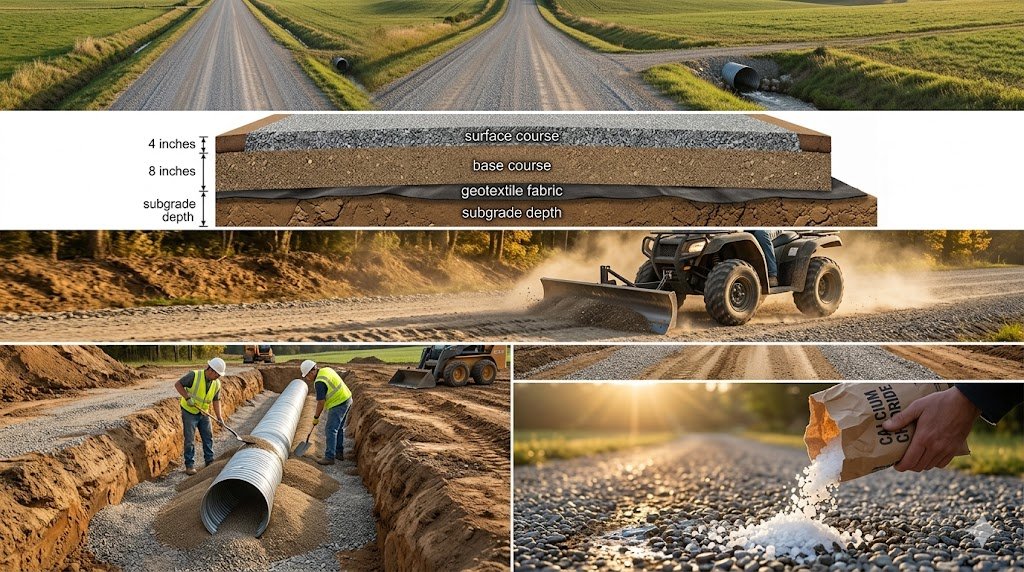
How a Gravel Road Is Actually Built
A well-built gravel road is a layered system, not just dirt covered with rocks. From bottom to top:
- Subgrade — the native soil, shaped and compacted. This is the foundation. The strength of the subgrade determines how much load the road can carry without failing. Clay-heavy or silty subgrades are weak; sandy or gravelly subgrades are strong.
- Geotextile fabric (optional but important) — a layer of woven fabric separating the subgrade from the base course. Prevents subgrade soil from mixing upward into the gravel over time. Not always present on older roads.
- Base course — 4–8 inches of coarser crushed stone (often 2-inch minus or 1.5-inch crusher run). This is the structural layer — it distributes vehicle loads across the subgrade. On many older private roads, this layer is absent or thin.
- Surface course — 2–4 inches of finer crusher run (3/4-inch minus with fines). This is the driving surface — it provides a smooth, compacted layer that sheds water and resists tire displacement.
Most private roads that give constant maintenance trouble are missing one or more of these layers — either the base course is too thin, there's no geotextile, or the surface material is wrong (clean stone instead of crusher run with fines).
The Three Things That Destroy Gravel Roads
1. Water
Water is the number one enemy of every unpaved road. Water in the subgrade weakens it — saturated soil loses most of its load-bearing capacity. Water on the road surface erodes material and creates channels. Water in freeze-thaw cycles heaves and disrupts the surface. Every gravel road maintenance decision ultimately comes back to drainage.
2. Speed
Vehicle speed is the primary cause of corrugation (washboard). At over 20 mph, tires bounce on the gravel surface and kick material forward, building ridges that grow into the classic washboard pattern. Slowing traffic from 25 mph to 15 mph reduces washboard formation rate by more than half.
3. Wrong Materials
Using clean washed stone instead of crusher run with fines, using pea gravel on a driveway, using topsoil to fill ruts — these mistakes guarantee constant maintenance problems because the material doesn't bind under compaction. See the gravel types guide for what to use and when.
The Four Core Maintenance Tasks
Task 1: Grading
Grading redistributes surface material back across the road, re-establishes the crown, and knocks down washboard ridges. It's the most frequent maintenance task. Depending on traffic, a well-maintained private road is graded 2–6 times per year. Equipment: ATV drag blade (light maintenance), box blade on compact tractor (full maintenance), or hired motor grader (best results, annual full grade).
Task 2: Drainage Maintenance
Keeping culverts flowing and ditches clear. Done twice a year minimum — spring (after snowmelt) and fall (before freeze-up). No grading work is effective long-term if drainage is poor. This is the highest-ROI maintenance task.
Task 3: Gravel Top-Dressing
Adding fresh gravel to replenish material lost to traffic, erosion, and migration. Typically needed every 3–5 years on a maintained road, more frequently on high-traffic or erosion-prone sections. Material: crusher run (dense-graded aggregate) with fines — not clean washed stone.
Task 4: Dust Control
In dry summer months, calcium chloride application keeps the surface damp and bound, reducing dust and slowing washboard formation. Applied 1–2 times per season. See the application guide for rates.
The Annual Maintenance Cycle at a Glance
| Time of Year | Primary Task | Secondary Tasks |
|---|---|---|
| Early spring (after thaw) | Assess frost damage, clear culverts | Ditch cleaning, seeding bare areas |
| Late spring | Full surface regrade + crown restoration | Gravel top-dress if needed |
| Early summer | Calcium chloride application | Check drainage after first heavy rains |
| Midsummer | Light maintenance grading | Second CaCl₂ application if needed |
| Early fall | Ditch cleaning | Final grading + crown check |
| Late fall | Culvert inspection and clearing | Mark road edges for plowing |
| Winter | Plow conservatively | Note problem areas for spring |
DIY vs. Hiring a Contractor: Quick Decision Guide
| Task | DIY Viable If... | Hire Out If... |
|---|---|---|
| Light grading/maintenance | You have an ATV + drag blade | Road is over 500 feet |
| Full regrade + crown | You have a tractor + box blade | Road needs precision crown work |
| Culvert installation | You can rent a mini excavator | Culvert is over 24" or near waterway |
| Gravel delivery | Always — quarry delivers | N/A |
| Ditch cleaning | Short sections with shovel or tractor | Long sections or hard soil |
| Soft spot repair | Small area, accessible | Recurring large soft spots |
Estimated Annual Maintenance Costs
Rough budgeting guidance for a typical 1/4-mile (1,320 feet) private road, 12 feet wide:
- Annual grading (contracted): $200–$400 for 1–2 motor grader passes
- Calcium chloride (DIY, 2 applications): $200–$400 for ~35 bags × 2
- Gravel top-dress (every 3–5 years): $1,500–$3,500 for 50–100 tons delivered and spread
- Culvert maintenance: $0 most years; $500–$2,000 for replacement every 20–40 years
- Total average annual cost: $500–$1,200 per year for a well-maintained 1/4-mile road
Your First Steps as a New Road Owner
Walk the entire road and document what you see
Look for washboard, ruts, soft spots, erosion channels, overgrown ditches, and culvert locations. Take photos. This baseline assessment tells you where to start.
Find every culvert and check that it flows
Probe each culvert — you should be able to see light through it. A blocked culvert is your most urgent problem, regardless of what else is wrong.
Assess the crown
Stand at one end of the road and sight down it. The center should be visibly higher than the edges. If the road is flat or has a center channel, crown restoration is a priority.
Identify the surface material
Is it crusher run with fines (looks dusty gray-brown, compacts firmly)? Or clean washed stone (individual stones visible, doesn't compact)? This tells you whether the material is right and whether additional gravel will help.
Get a grading quote
Call 2–3 local excavating or land clearing contractors and ask for a quote to grade your road. Describe the length, width, and current condition. Compare quotes and ask what they include — scarifying, full regrade, crown work. This establishes your baseline maintenance cost.
Frequently Asked Questions
Indefinitely, with ongoing maintenance. Unlike asphalt, gravel roads don't have a structural lifespan — they degrade without maintenance and can be restored to good condition with proper work. Roads that have been maintained for 100 years still perform well. The key variables are drainage (well-drained roads last far longer) and base construction quality (roads with adequate base depth and separation fabric require far less ongoing maintenance).
Paving eliminates many maintenance issues but introduces others — cracking, frost heave damage to asphalt, expensive repairs when it does fail. For driveways under about 300 feet, asphalt paving ($3–$6 per square foot) is often cost-competitive with the long-term cost of gravel maintenance. For rural roads over 500 feet, gravel is almost always the economical choice. For shared private roads with multiple property owners, gravel avoids the substantial cost of asphalt installation and the conflict over repair responsibility when sections fail.
For a driveway under 300 feet: a pull-behind ATV drag blade ($150–$350) and an ATV or UTV with a tow hitch handles all routine maintenance grading. For longer roads: a compact tractor with a box blade is the most versatile setup for DIY road maintenance. If you don't own a tractor, equipment rental for seasonal maintenance ($150–$300/day for tractor + box blade) is often more practical than ownership for roads under 1/4 mile.
Continue reading: Full seasonal maintenance calendar | What gravel to buy | Fix washboard now